Run a bank.
Stay one.
You are appointed chief executive of a small bank in a real jurisdiction and a real year. You run it from a terminal: the funding stack, the capital stack, the credit desk, the agencies, the supervisor, the board and the paper. The economics close monthly. The clock runs by the day.
It assumes you know what a basis point is.
Treasurers, risk and credit officers, supervisors, analysts, students of the trade, and anyone who has sat in an ALCO and wondered what the other side of the table was thinking. The Handbook explains the rest, one article per mechanic, with a worked example from your own numbers and a sandbox you can move.
Dry committee English
No cartoons, no confetti. The supervisor's letter is on paper and reads like one. The CFO writes a paragraph at the close. The paper has a column about you.
Monthly economics, a daily clock
Placement books fill over days. Tenders answer over days. Decisions with a deadline stop the clock. Hold B to run at thirty times.
Mandates on your own record
Wholesale funding, hedging, securitisation, cross-border, AT1, internal models, buybacks: each granted after an exam the board opens only when your history qualifies.
Every function a bank's executive committee sees, by code.
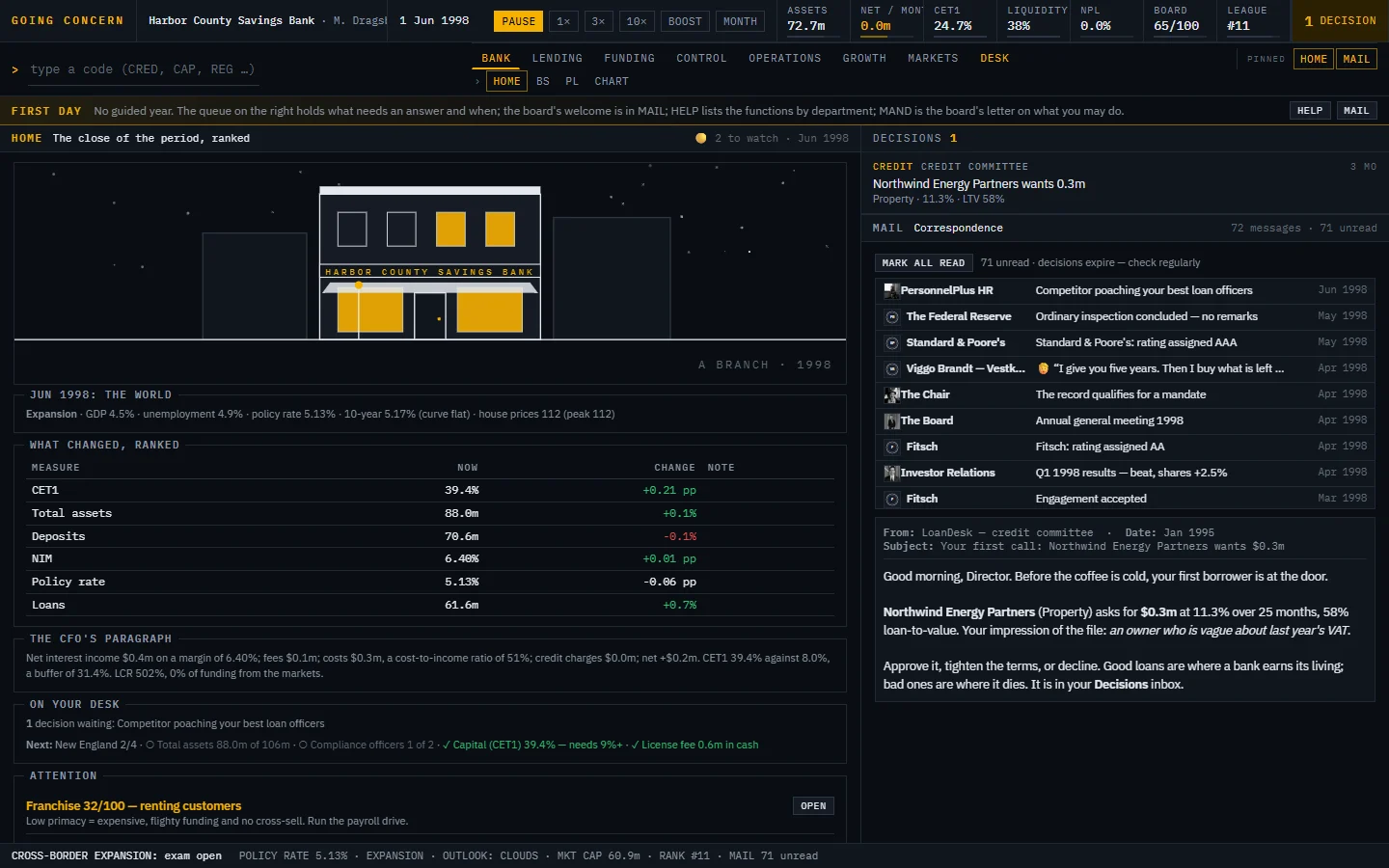
Type a code on the command line, or click it. Two panes and a queue, or floating windows if you prefer a workstation. Every picture on this page is the desk itself.
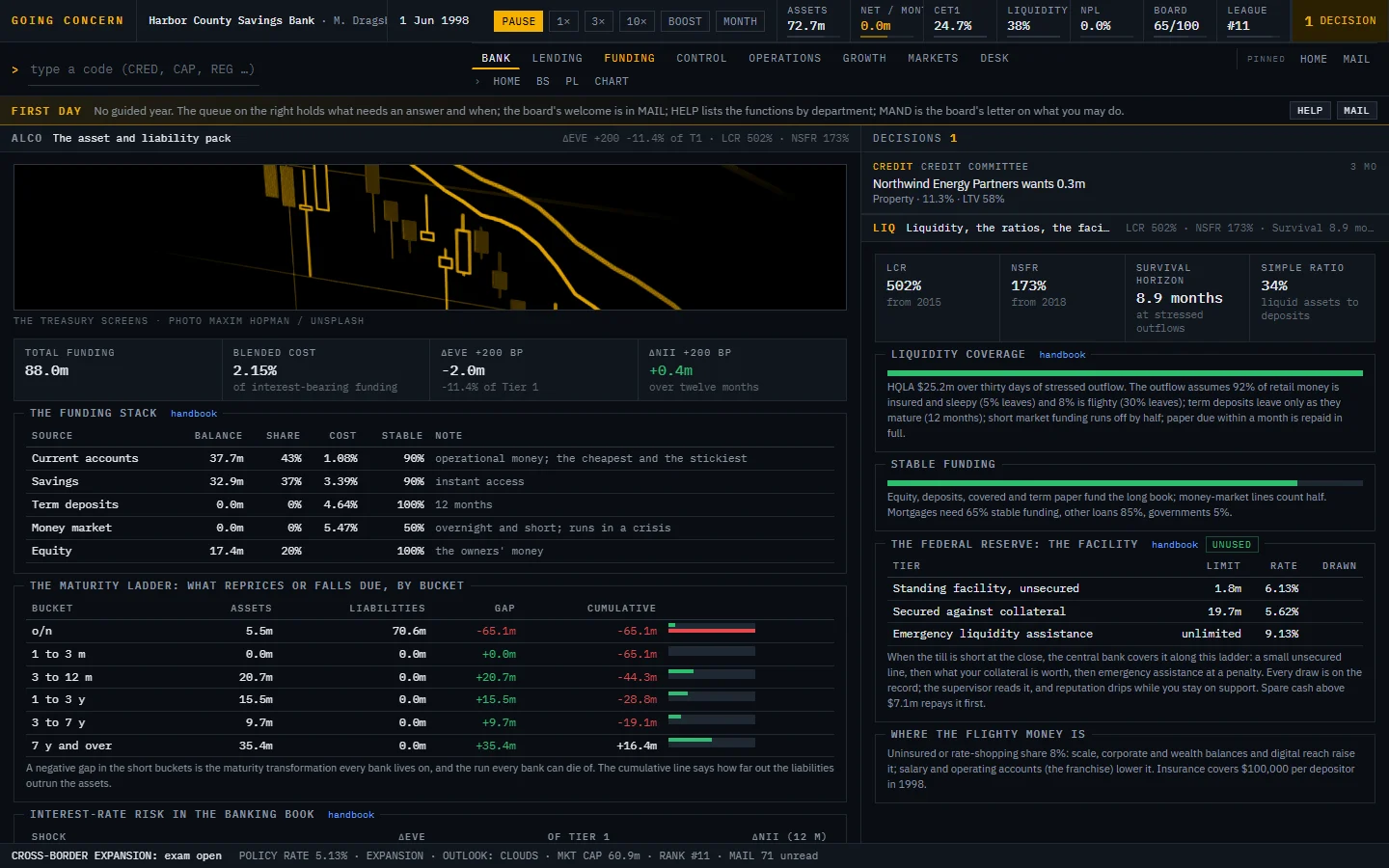
The funding stack and the pack
Certificates of deposit, senior paper, covered bonds, Tier 2 and AT1, each with a maturity and a call. The ladder, the gap, ΔEVE and ΔNII. The facility with its stigma. Liquidity coverage counted net of the loss the ratio cannot see.
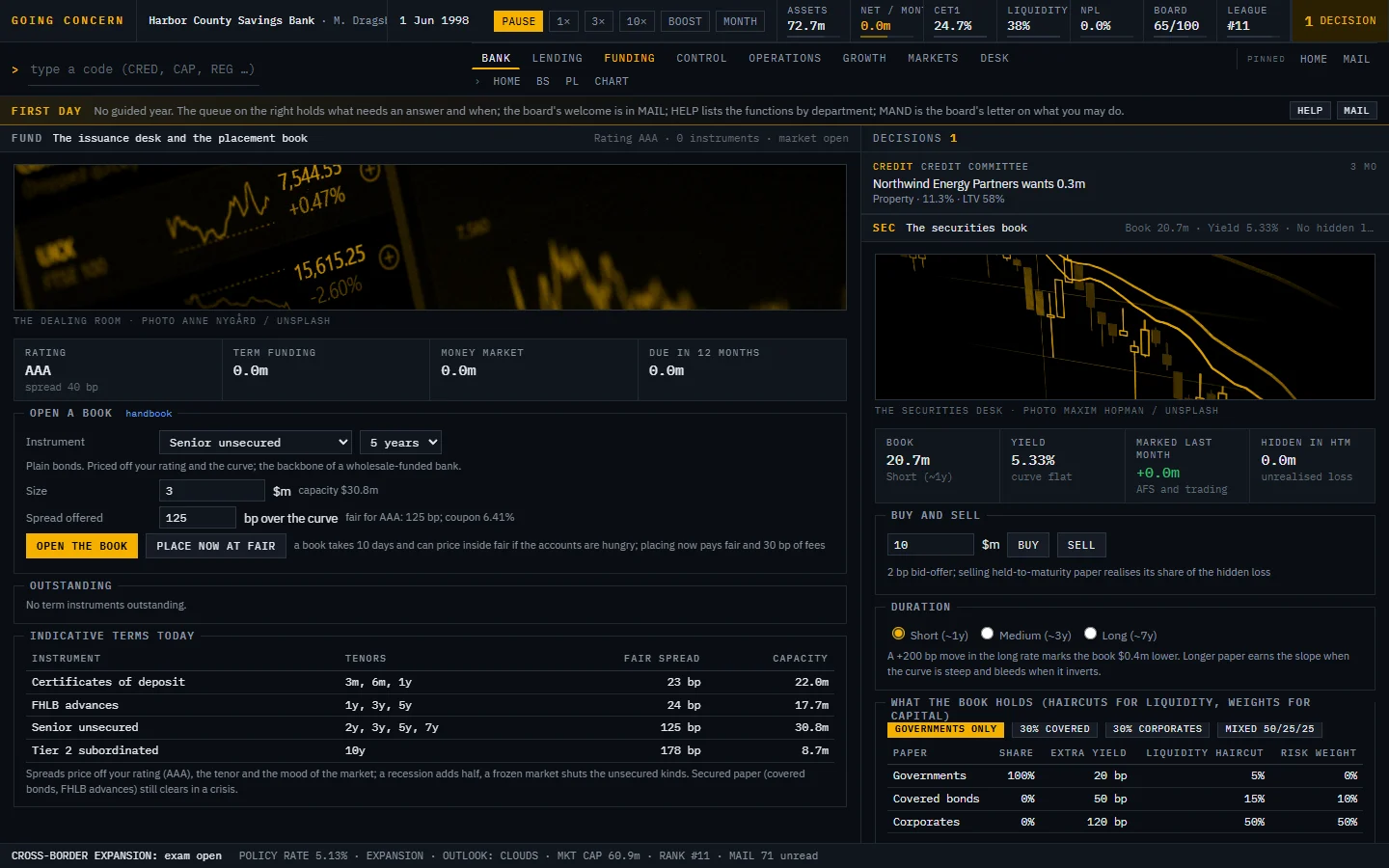
The placement book
Circulate a bond to eight named accounts and watch the book fill over days. Price it tighter than your rating allows and it closes thin. The securities book by class and by level, with the held-to-maturity loss that leaks into the uninsured money.
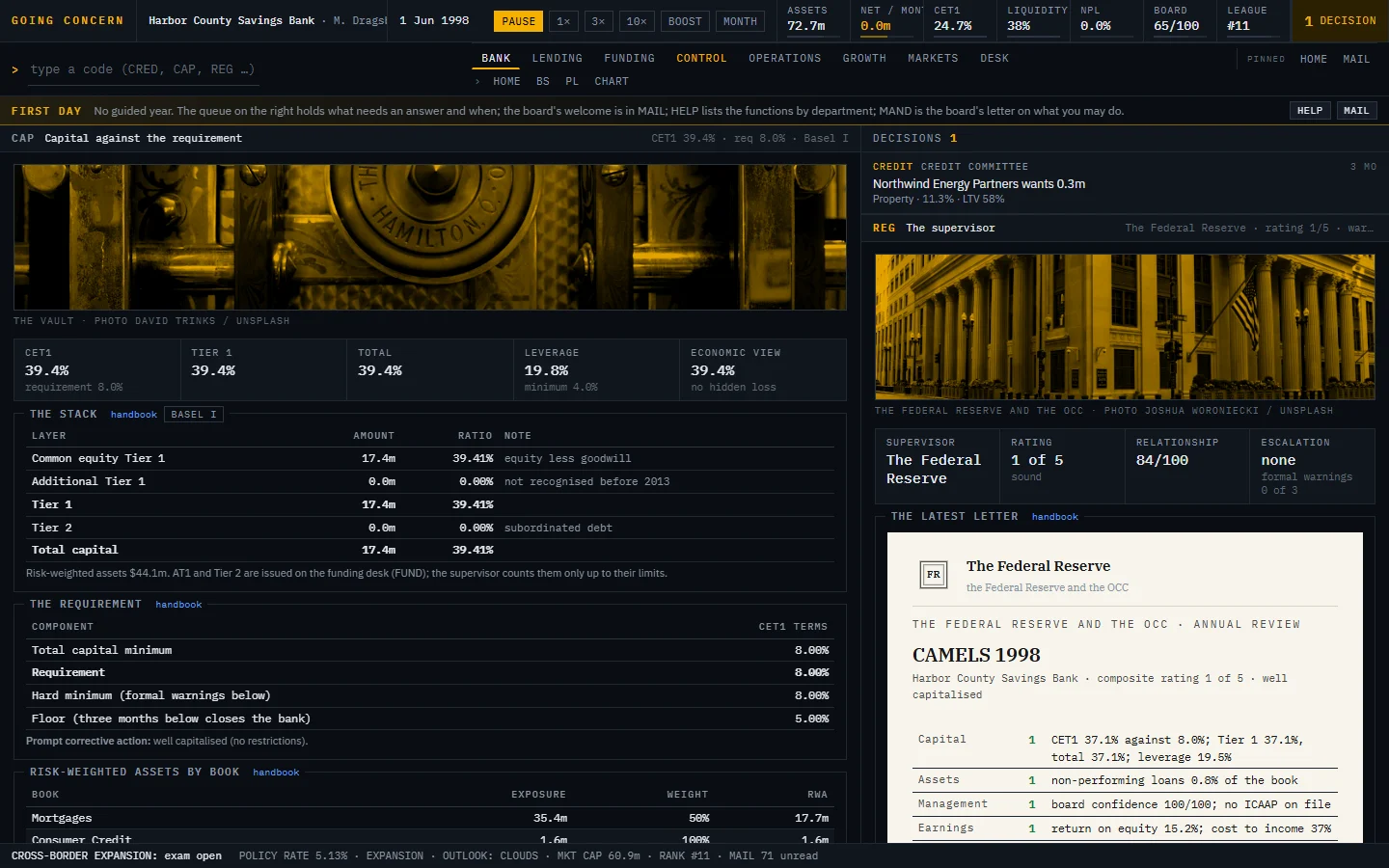
Capital against the requirement
Basel I, II and III as they applied. The buffers, the Pillar 2 add-on, the maximum distributable amount. The supervisor’s annual review on paper: CAMELS in the United States, SREP in Europe, six graded components and a letter on file.
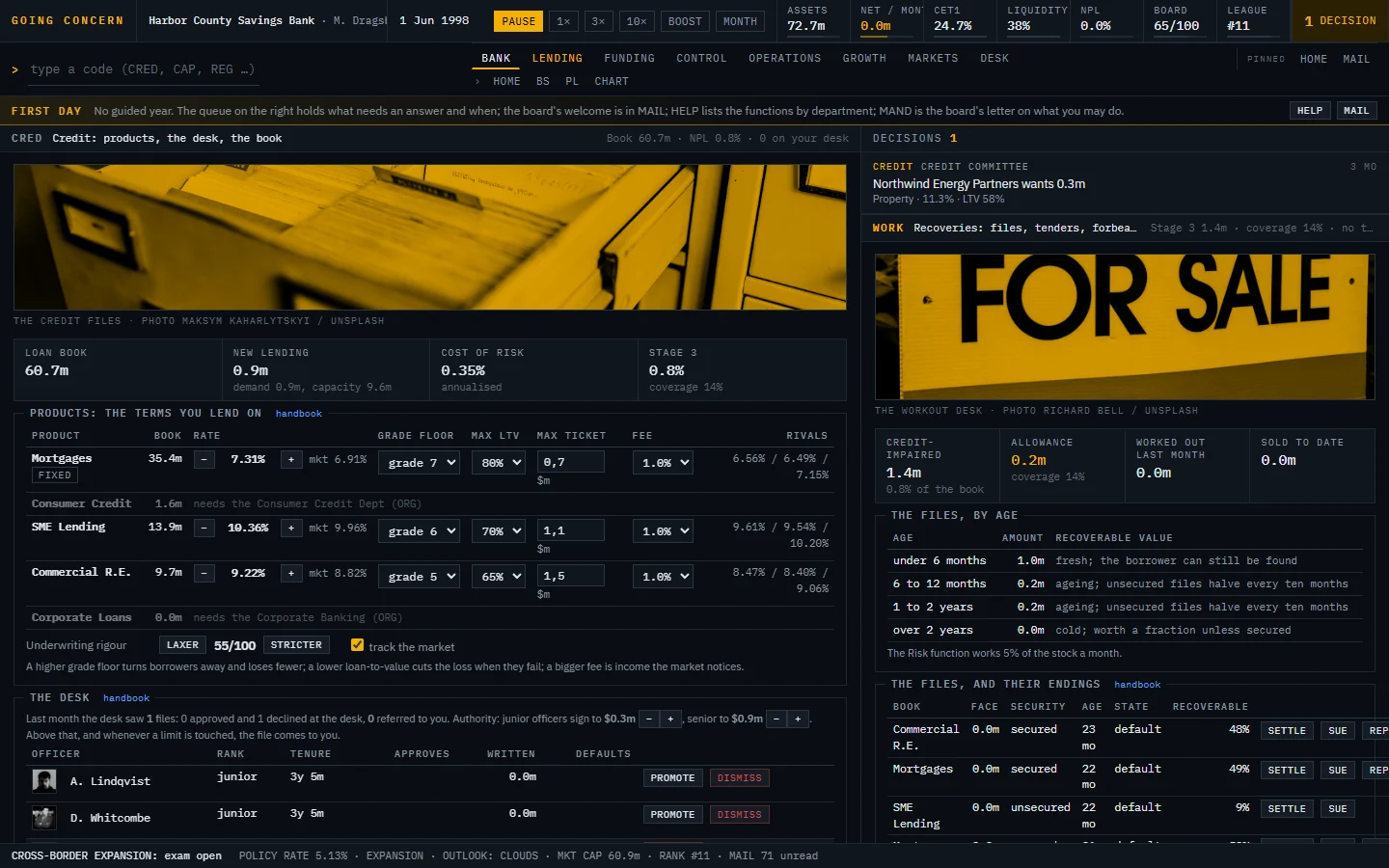
The credit desk
Products you design: a grade floor, an LTV cap, a ticket cap, a fee. Officers settle routine files under their own authority and refer the rest with a reason. The memorandum. Stages. Sector limits. A recoveries desk with an arrears window, tenders, forbearance and three endings per file.
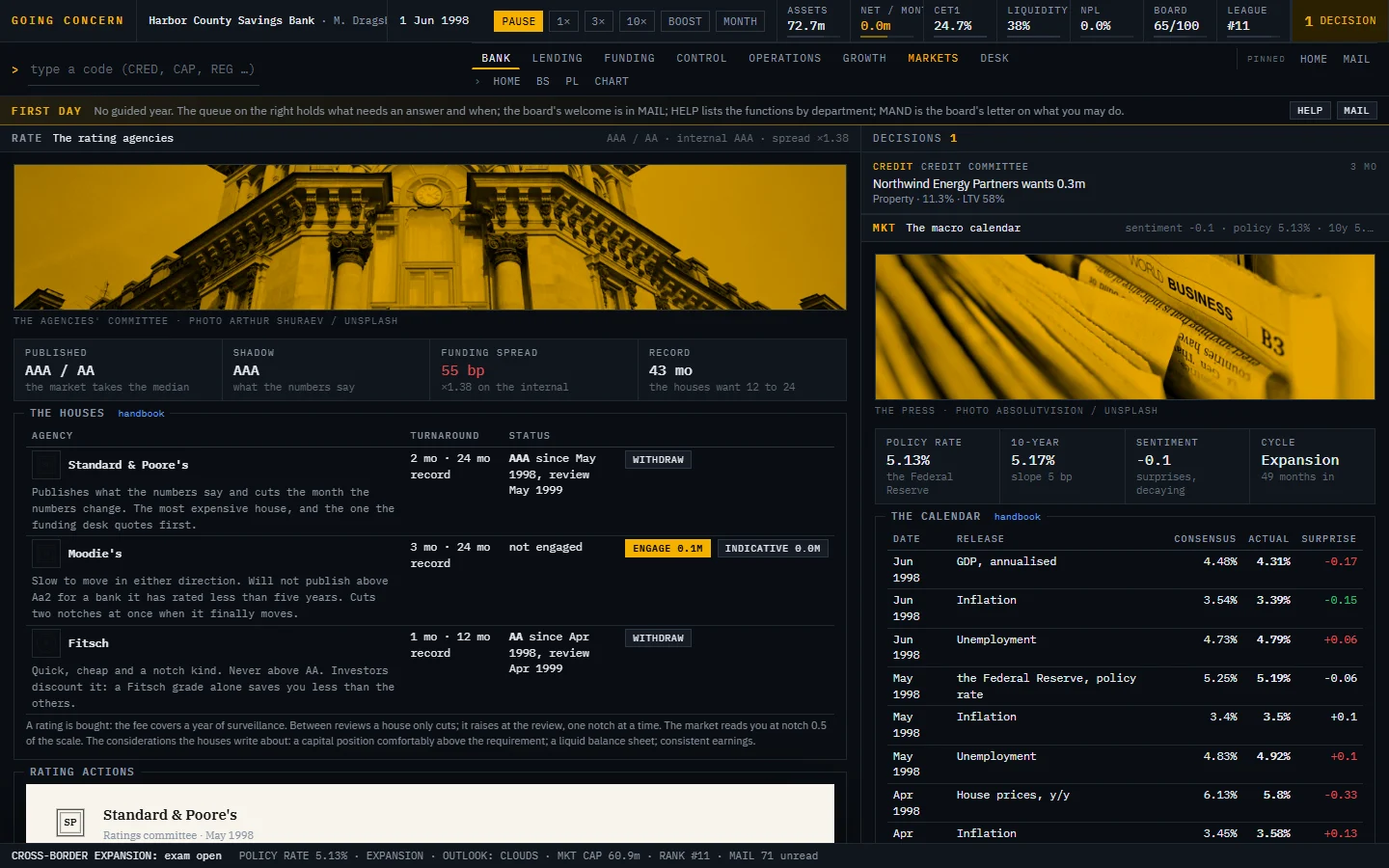
Three agencies with temperaments
A rating is bought: a fee, a turnaround, a minimum age. One house publishes what the numbers say, one waits and cuts two notches at once, one is a notch kind and discounted for it. Between reviews they only cut. The letter names the principal considerations.

The Ledger, and the board
A financial daily with a front page ranked from your month, a column about the weakest thing you do, public notices to tender for and classifieds. The board pack as a document. The general meeting in April, with five resolutions that can be lost.
Real jurisdictions. Real years. Fictional banks.
Take office in the United States, the United Kingdom, the euro area, Switzerland, Singapore or Norway, in 1988, 1995, 2008, 2015 or 2020. The policy rate, the curve, growth, unemployment and house prices are the century's own. The regulators change name and temper on schedule. Deposit insurance and the countercyclical buffer move by year. Basel I, II and III arrive when they arrived. The rivals have names you will almost recognise, and the ones that fell, fall when they fell.
Take over mid-crash
House prices falling, the uninsured money nervous, the Fed cutting toward zero, and a window to buy the rivals who did not keep a buffer.
Negative rates, then the hiking cycle
A long held-to-maturity book against flighty deposits is the SVB trade. The ratio will not show you the loss. The analysts will.
The Nordic banking crisis, on schedule
The late-eighties boom, the property book, and the three years that followed. Standards at the peak decide the losses in the trough.
One article per mechanic, with a sandbox.
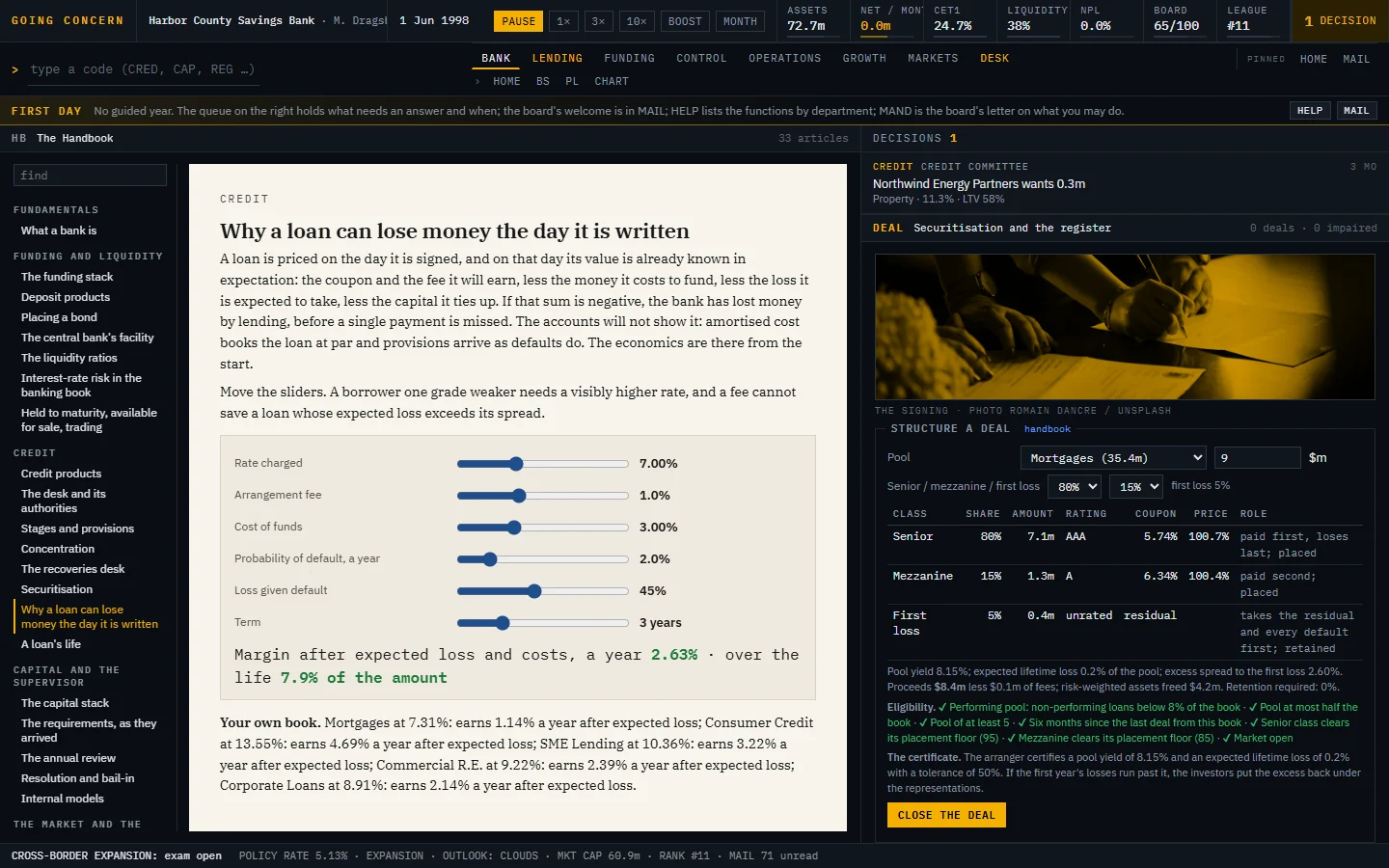
Written the way a bank's own treasury and risk handbook is written. The exam questions point at the article that answers them. Here is one of the sandboxes: a loan is priced on the day it is signed, and on that day it can already have lost money.
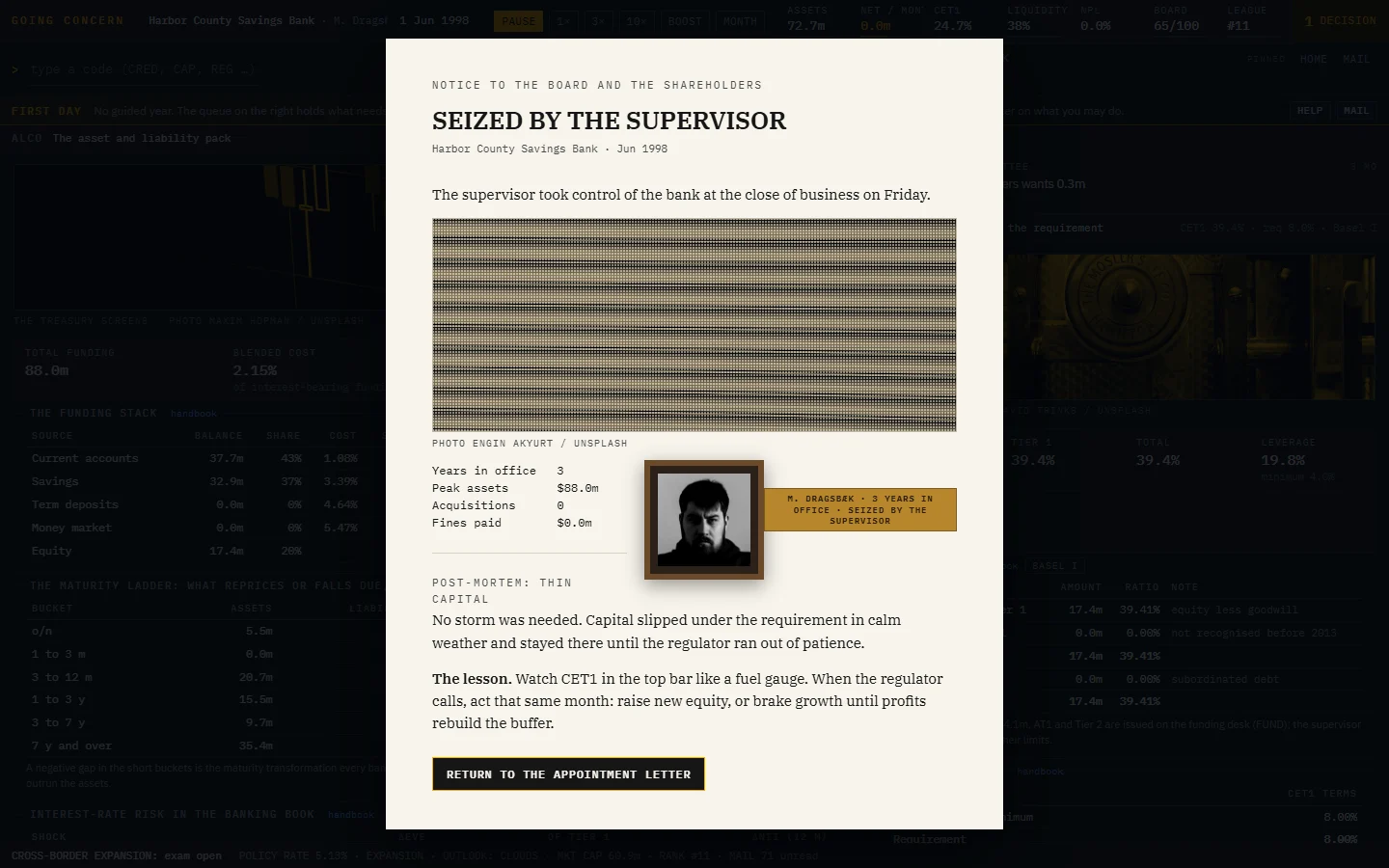
Dismissed, seized, resolved, acquired, or retired.
The board dismisses below twenty at the January review. The supervisor seizes after three months below the floor. From 2016 in Europe and 2010 in the United States, a failing bank is resolved and its own capital and debt are written down. A rival may buy you the month you look weak. Or you announce your retirement with a successor in place, and the record says what you built and whether it outlived you.
The notice is on paper, and it says which.
The articles, for the parts the Handbook assumes.
How banks make money
Net interest margin, fees and the spread.
The CET1 ratio
Bank capital, in plain terms.
How bank runs happen
From Northern Rock to SVB.
Duration and interest-rate risk
Why the long book hurt in 2022.
Why banks fail
The six classic killers.
All articles
G-SIBs, Basel III, the curve and more.
What people ask.
What is Going Concern?
Going Concern is a bank simulation for people who work in finance. You are appointed chief executive of a small bank in a real jurisdiction and a real year, and you run it from a terminal: the funding stack, the capital stack, the credit desk, the agencies, the supervisor, the board and the paper. The economics close monthly; the clock runs by the day.
Who is it for?
Treasurers, risk and credit officers, supervisors, analysts, students of the trade, and anyone who has sat in an ALCO. It assumes you know what a basis point is. The Handbook explains everything else, one article per mechanic, with a worked example from your own numbers.
Is it free?
Yes. It runs in the browser with no download. Careers save on the device as a guest, or to an account so they follow you.
How realistic is it?
The engine enforces the accounting identity every month. Six jurisdictions carry their real policy rates, curves, growth, unemployment and house prices from 1988 to 2025, with the regulators of the day, deposit insurance by year, Basel I to III arriving on schedule, and rivals whose fates are scheduled. The banks are fictional.
How does a career end?
Dismissed by the board, seized by the supervisor, resolved and bailed in, acquired, or retired on your own terms with a successor in place. The notice is on paper and it says which.
What happened to SejrBank?
Going Concern is its relaunch, rebuilt for a professional audience. The old game stays at sejrbank.com/banking for anyone with a career running there.
Sign and take office.
One page of paper: the chairman's letter appointing you, the bank, the jurisdiction and the year. Then the desk, with the first credit file already waiting.